How to Grow on Twitter by Replying to Foreign Language Tweets (The Untapped Growth Hack)
60% of Twitter's daily activity happens in Japanese, Spanish, Korean, and Portuguese — and most English creators ignore it completely. Here's how to turn that into your biggest growth advantage.
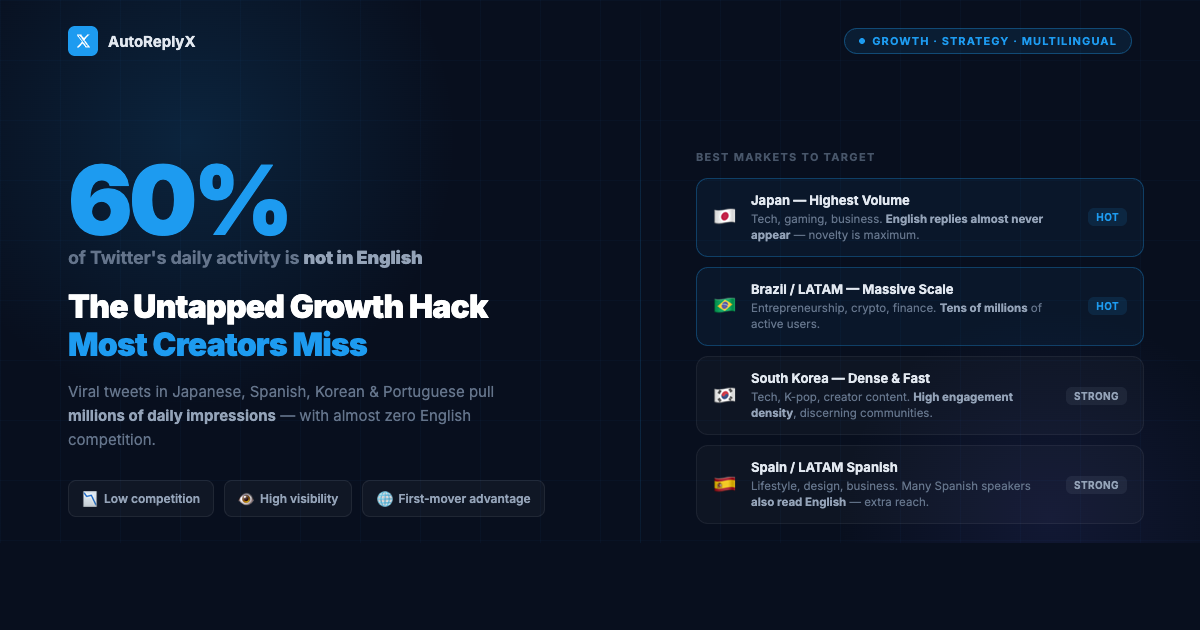
Most Twitter creators hustle in a 40% pond while a 60% ocean sits untouched next door.
That’s not a metaphor. Over 60% of Twitter’s daily activity happens in languages other than English — Japanese, Spanish, Korean, Portuguese, Arabic. Every day, thousands of tweets in those languages go viral, pull in massive engagement, and get seen by millions of people.
And almost no English-speaking creators show up in those threads.
That’s the opportunity. This post breaks down exactly how to exploit it.
The Hidden 60%: Why Most Twitter Creators Are Ignoring the Biggest Engagement Pools
When you scroll Twitter, your feed is shaped by who you follow and what the algorithm thinks you want. For most English-speaking creators, that means an almost entirely English feed.
But Twitter’s global reality looks very different:
- Japan is one of Twitter’s most active markets — Japanese users tweet more per capita than almost any other country. Tech, gaming, anime, and business conversations are enormous there.
- Latin America (Brazil + Spanish-speaking countries) has hundreds of millions of active users. Entrepreneurship, crypto, and personal finance content spread fast.
- South Korea has one of the highest social media usage rates in the world. K-pop, tech, and lifestyle content pulls massive numbers.
- Portugal and Brazil share Portuguese as a language, creating a combined market that dwarfs many English-speaking countries.
These aren’t niche communities. They’re some of the most active, engaged audiences on the platform.
And most creators competing in those spaces? They’re talking to each other. An English-speaking voice in a Japanese tech thread stands out immediately — because it almost never happens.
Why Replying Beats Posting for Early-Stage Growth
If you’re not already building a large following, original posts mostly land in a vacuum. You spend 30 minutes writing the perfect tweet. It gets 12 impressions. Three of them are you checking on it.
Replying works differently.
When you reply to a tweet that already has momentum — thousands of likes, active engagement, the algorithm pushing it to new audiences — your reply rides that wave. People reading the thread see your name. If your reply adds value, they check your profile. Some follow.
This is how new accounts break through. Not by posting into the void, but by showing up in conversations that already have an audience.
Now combine that strategy with a market where almost no one else competes.
A smart English reply on a viral Japanese tech tweet gets noticed. It’s unusual. It signals international credibility. People engage with curiosity. The algo treats that engagement the same regardless of language — and your impressions spike.
The Cross-Language Reply Advantage: Low Competition, High Visibility
Here’s the math that makes this strategy so powerful:
On a viral English tweet with 10,000 likes, there might be 500 replies. You’re fighting for attention in a crowded thread. Standing out requires a genuinely exceptional reply.
On a viral Japanese tweet with 10,000 likes, there might be 200 replies — almost all in Japanese. An English reply that’s on-topic and well-written? It’s practically the only one. It will get seen.
The visibility-to-effort ratio is completely different.
This advantage exists because:
- The language barrier filters out most competition. Most creators can’t write in Japanese, Korean, or Spanish at a native enough level to sound credible.
- Novelty attracts attention. Foreign language communities notice when someone from outside engages thoughtfully. It’s a pattern interrupt in their feed.
- First-mover advantage is still wide open. This isn’t a saturated strategy. Very few creators are doing it systematically.
Step-by-Step: How to Find and Reply to Foreign Viral Tweets
Pick Your Target Market Based on Your Niche
Not all foreign language markets will be relevant to you. Match your content to where the audience overlap is:
| Your Niche | Best Markets to Target |
|---|---|
| Tech / SaaS / Dev | Japan 🇯🇵, South Korea 🇰🇷 |
| Business / Entrepreneurship | Brazil 🇧🇷, Mexico/LATAM 🇲🇽, Spain 🇪🇸 |
| Finance / Crypto | Brazil 🇧🇷, South Korea 🇰🇷, Argentina 🇦🇷 |
| Design / Creative | Japan 🇯🇵, France 🇫🇷 |
| Lifestyle / Fitness | Brazil 🇧🇷, Spain 🇪🇸 |
| Gaming | Japan 🇯🇵, South Korea 🇰🇷 |
Starting with one market is better than spreading thin across five. Pick the market most relevant to your niche and go deep.
How to Spot a Viral Tweet in Another Language
You don’t need to read Japanese to find a viral Japanese tweet. You need to recognize the signals:
- High like count — a tweet with 5,000+ likes already has proven traction
- High reply count — active conversation means the algorithm is still pushing it
- Recent timestamp — replying within the first few hours of a tweet gaining momentum gives you the most visibility
- Topic alignment — use Twitter’s search with keywords in your niche alongside the language filter (Settings > Search filters, or add
lang:jato your search query)
Tools like Tweetdeck let you set up columns filtered by language and keyword, so you can monitor viral content in your target market in real time.
How to Write a Reply That Sounds Native
This is where most people get stuck — and where the opportunity becomes real.
A bad foreign language reply gets ignored or mocked. A good one sparks engagement.
What makes a reply “good” in a foreign language thread:
- It’s on-topic. Even if it’s in English, it should clearly respond to the content of the tweet — not just say “great post!” in the native language.
- It adds value. A data point, a perspective, a genuine question, a brief insight. Something that contributes to the conversation.
- It’s written at native quality in your own language. If you’re writing in English, write it well. People from other markets often understand English and will judge the quality of your writing.
- Optional: open with one sentence in their language. A short, accurate phrase in Japanese or Spanish before your English reply shows respect for the community and dramatically increases engagement. Even one correct sentence makes a difference.
For that last point — writing that native-quality sentence — this is exactly where most creators hit a wall. Google Translate gives you technically correct text that sounds robotic. ChatGPT helps, but takes 3-4 minutes of back-and-forth per tweet.
Before vs. After: The Manual Workflow vs. The AutoReplyX Workflow
The Manual Workflow (What Most Creators Do)
- Find a viral tweet in Japanese
- Copy the tweet text
- Open ChatGPT in a new tab
- Write a prompt: “Translate this tweet, explain the context, and write me a reply that sounds natural”
- Wait for the output
- Copy the reply
- Switch back to Twitter
- Paste, re-read, edit
- Post
Total time: 4–5 minutes per reply. If you’re doing 10 replies a day, that’s close to an hour in context-switching overhead — before writing a single original post.
The AutoReplyX Workflow
- Find a viral tweet in Japanese
- Copy the tweet URL
- Paste it into AutoReplyX
- Read the generated reply + translation preview
- Post
Total time: under 30 seconds.
AutoReplyX fetches the tweet, detects the language, understands the context, and generates a native-quality reply — alongside a translation so you always know exactly what you’re posting. No prompt engineering. No app-switching. No guessing.
Results Creators Are Seeing
Early users of AutoReplyX are reporting significant impression spikes after adding foreign language replies to their strategy.
The pattern is consistent: creators who engage thoughtfully in 2–3 foreign language threads per day see their weekly impression counts climb within the first week — often by 30–50% — without posting more original content.
Why? Because they’re showing up where the competition isn’t.
One user described it this way:
“I replied to three Japanese tech tweets on a Monday morning. By Wednesday, I had 40 new followers from Japan and my impressions had doubled. I’d never had a follower from Japan before.”
The math is straightforward. You’re accessing engagement pools that English-only creators ignore entirely. The accounts you’re reaching have never seen you before. And the cost of entry — a well-written reply — is now dramatically lower.
Start Tapping Into the 60%
Most Twitter creators are competing for a fraction of the platform’s total engagement. The other 60% is sitting there, underserved and high-opportunity.
You don’t need to be fluent in Japanese or Spanish to access it. You need a strategy and the right tool.
AutoReplyX gives you 10,000 free credits on signup — that’s 100 replies, no credit card required.
Get your free credits at app.autoreplytool.com →
Start with one market. Find one viral tweet. Reply once.
Then watch what happens to your impressions.
Ready to try it yourself?
Start with 10,000 free credits — no credit card required.
Get 10,000 Free Credits →